
Feeding the right amount of a high-quality dog food is one of the simplest things you can do to help keep your dog healthy. Feed too much and you put your dog at risk for obesity. Feed too little and nutritional deficiencies are possible.
If you’re wondering “how much food should I feed my dog?” you’re in the right place. Our dog feeding guide is here to help.
Have you ever stared at a can of dog food wondering if you’re about to serve your furry friend too much or too little? Trust me, you’re not alone! As a pet parent who’s spent countless hours researching proper dog nutrition, I’ve discovered that feeding the right amount of wet food is both an art and a science.
Why Proper Portions Matter
Before we dive into exact measurements, let’s talk about why getting this right is so important. Feeding your dog the correct amount helps:
- Prevent obesity (which affects a shocking 59% of dogs!)
- Ensure they get proper nutrition
- Maintain healthy energy levels
- Support their immune system
- Potentially extend their lifespan
According to veterinary experts, many of us are actually overfeeding our dogs without realizing it. One common mistake? Assuming one can equals one serving!
Understanding Wet Food Portions
Unlike dry kibble, wet food has higher moisture content, which means portions work differently Let’s break down how to calculate the right amount.
The Basic Formula
Most canned dog food recommends feeding about 1 can per 15 pounds of body weight per day But this is just a starting point! You’ll need to adjust based on
- Your dog’s weight and size
- Age (puppy, adult, or senior)
- Activity level
- Reproductive status
- Current body condition
Examples by Weight
Here’s a quick reference guide for daily portions based on the 1 can per 15 lbs rule:
| Dog’s Weight | Daily Wet Food Amount |
|---|---|
| 7 pounds | Roughly 1/2 can |
| 15 pounds | 1 can |
| 30 pounds | 2 cans |
| 60 pounds | 4 cans |
| 90 pounds | 6 cans |
Remember, these are DAILY amounts! If you feed your dog twice daily (which is recommended for most dogs), you’d divide these amounts in half per meal
Age-Specific Considerations
Your dog’s age significantly impacts how much wet food they need.
Puppies
Puppies are little eating machines! They need:
- More calories
- Higher protein
- Extra nutrients to support growth
For puppies, you might need to increase the amount by 20-40% compared to adult portions. Always look for wet food specifically formulated for puppies.
I remember when my Lab was a puppy – he seemed like a bottomless pit! But following proper portions helped him grow at a healthy rate.
Adult Dogs
Adult dogs have more stable nutritional needs. The standard formula of 1 can per 15 pounds works well as a starting point for most healthy adults.
Senior Dogs
As dogs enter their golden years (typically 7-12 years depending on breed size), their metabolism slows down. Senior dogs usually need:
- Fewer calories
- More fiber to stay full
- Joint-supporting nutrients
For seniors, you might reduce portions by 10-20% compared to adult amounts, unless your vet advises otherwise.
Mixing Wet and Dry Food
Many of us use the “Full Circle Feeding” approach, mixing wet and dry food for variety and nutrition. This is fantastic for your dog but requires some math to avoid overfeeding.
When mixing foods, follow this simple rule:
For every 1/2 can of wet food you add, subtract about 1/3 cup of kibble.
This balance ensures your dog gets the benefits of both food types without excess calories.
Signs You’re Feeding the Right Amount
How do you know if you’ve got it right? Watch for these indicators:
- Maintaining a healthy weight
- Visible waistline when viewed from above
- Able to feel (but not see) ribs
- Consistent energy levels
- Regular, healthy bowel movements
- Satisfaction after meals without begging
If your dog seems hungry all the time despite getting proper portions, try dividing the daily amount into more frequent, smaller meals.
Common Mistakes to Avoid
In my years of dog parenting, I’ve seen these mistakes repeatedly:
- Eyeballing portions instead of measuring
- Assuming one can equals one serving for all dogs
- Not adjusting portions as your dog ages
- Forgetting to count treats in the daily calorie count
- Using the same feeding guide for wet food as dry food
Creating a Custom Feeding Plan
Here’s my step-by-step approach to figuring out exactly how much wet food YOUR dog needs:
- Weigh your dog accurately (vet scale is best)
- Check the feeding guidelines on your specific wet food
- Start with the recommended amount based on weight
- Adjust based on age, activity level, and body condition
- Monitor weight and appearance over 2-3 weeks
- Make small adjustments (±10%) as needed
- Consult your vet if you’re unsure
Special Situations
Weight Management
If your dog needs to lose weight, reduce portions by about 10% and increase exercise. Slow and steady weight loss is healthiest.
For my overweight Beagle, we reduced his portions by just a bit and added an extra walk daily – it made a huge difference over time!
Very Active Dogs
Working dogs, sport competitors, or just naturally active pups may need 30-50% more calories than their couch potato counterparts.
Health Conditions
Dogs with certain health issues like kidney disease, diabetes, or gastrointestinal problems may need very specific feeding amounts. Always follow your vet’s guidance in these cases.
Making Portions Foolproof
To make daily feeding easy and consistent:
- Use measuring cups designed for wet food
- Create a custom scoop from an empty food container cut to the exact portion size
- Consider pre-portioning weekly servings in containers
- Use a food scale for precise measurements
Bottom Line on Wet Food Portions
There’s no one-size-fits-all answer to how much wet food to feed your dog. Start with the manufacturer’s guidelines, adjust based on your dog’s individual needs, and monitor their body condition regularly.
Remember, feeding the right amount is one of the simplest yet most powerful things you can do to keep your dog healthy throughout their life. And don’t forget – your veterinarian is always your best resource for specific feeding advice tailored to your pet’s unique needs.
Have you found the perfect portion for your pup? It took me some trial and error, but the healthy shine in my dog’s coat and his boundless energy tell me we’ve got it right!
FAQs About Wet Food Portions
How do I know if I’m feeding my dog too much wet food?
Watch for weight gain, lethargy after meals, or loose stools. If you notice these signs, gradually reduce portions by about 10%.
Is wet food better than dry kibble?
Neither is necessarily “better” – they each have advantages. Wet food provides more moisture and is often more palatable, while dry food is convenient and helps clean teeth.
Should I feed the same amount of wet food every day?
Consistency is important for digestive health, but you can adjust portions slightly based on activity levels. For instance, after an extra-active hiking day, a small portion increase might be appropriate.
What if my dog always seems hungry?
Some dogs (I’m looking at you, Labradors!) have seemingly bottomless appetites. If your dog is at a healthy weight but always begging, try dividing their daily food into more frequent, smaller meals or adding low-calorie vegetables like green beans to help them feel full.
Remember, the goal isn’t just to satisfy hunger – it’s to provide optimal nutrition for a long, healthy life. Getting portions right is key to achieving that goal!
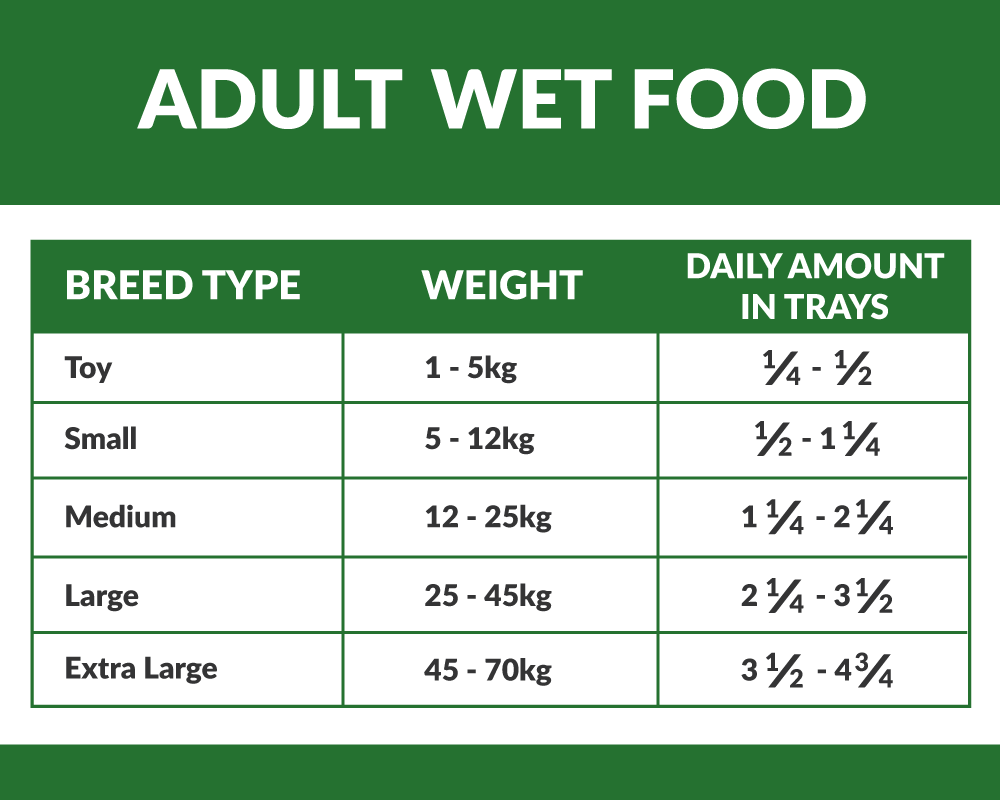
Adult Dog Feeding Chart
Healthy adult dogs are the easiest to feed. They’re done growing, so their nutritional needs should be fairly consistent over time—unless something big changes in their lives.
The most important factor is their weight.
Use your dog’s ideal weight to figure out how much food to offer. This target weight goal may be lower than your dog’s actual weight if they’re overweight, or a little higher if they’re too thin. Get your dog weighed at their next vet appointment and keep track of their weight or opt for a pet scale, like the Brecknell MS15, to do it at home.
Let’s look at an example of how much to feed your dog. Below is the feeding guide for the Purina Pro Plan dry dog food.
The food contains 379 calories (kcal) per cup, so the ranges would be similar for any adult dog food that has a similar calorie content:
| Weight Range | Feeding Amount Per Day |
|---|---|
| 3–12 pounds | ½–1¼ cup |
| 13–20 pounds | 1¼–1⅔ cups |
| 21–35 pounds | 1⅔–2⅓ cups |
| 36–50 pounds | 2⅓–3 cups |
| 51–75 pounds | 3–3¾ cups |
| 76–100 pounds | 4–4⅔ cups |
| Over 100 pounds | 4⅔ cups, plus ⅓ cup for each 10 pounds of body weight over 100 pounds |
Puppies are more complicated.
In their early months, they require extra calories, protein, and other nutrients to fuel their growth.
Large and giant dog breed puppies have different nutritional needs than small- and medium-breed puppies, and they should be fed a large-breed puppy formula for proper bone and joint development. Talk to your vet about which formula is best for your puppy, how much to feed as they grow, and how long to feed the puppy formula.
As they get closer to their full-grown size, their nutritional needs become more like those of an adult dog. So look up both your puppy’s current weight and their age to determine how much dog food to give your dog.
This feeding guide for the Blue Buffalo Wilderness Rocky Mountain Recipe makes it easy to determine how much to feed your puppy as they get older:
| Weight Range | Feeding Amount Per Day: 1–3 Months Old | Feeding Amount Per Day: 3–5 Months Old | Feeding Amount Per Day: 5–7 Months Old | Feeding Amount Per Day: 7–12 Months Old |
|---|---|---|---|---|
| Up to 5 pounds | ½–1 cup | ½–¾ cup | ¼–½ cup | ¼–½ cup |
| 6–10 pounds | 1–1½ cups | ¾–1 cup | ½–1 cup | ½–¾ cup |
| 11–20 pounds | 1½–2½ cups | 1–1¾ cups | 1–1½ cups | ¾–1¼ cups |
| 21–40 pounds | 2½–4¼ cups | 1¾–3 cups | 1½–2½ cups | 1¼–2¼ cups |
| 41–60 pounds | 4¼–5¾ cups | 3–4 cups | 2½–3½ cups | 2¼–3 cups |
How Many Times a Day Should a Dog Eat?
You may have noticed that dog feeding guides tell you how much dog food to feed per day. But most dogs shouldn’t have just one meal a day, so you’ll have to divide the amount of food on the feeding chart by the number of meals your dog eats daily.
Recommendations vary, based on a dog’s size and age:
- Large and giant breeds:
- For puppies up to 4 months of age: three meals per day
- For adults and seniors: two to three meals per day
- Small and medium breeds:
- For puppies up to 4 months of age: three meals per day
- For adults and seniors: two meals per day
- Toy breeds:
- For puppies up to 4 months of age: four to five meals per day
- For puppies 4–6 months of age: three meals per day
- For dogs 6 months of age and older: two meals per day