
Dogs were used on all fronts and in a variety of roles during World War II.
Animals of several kinds were used during WW2 by the military forces of belligerents both large and small. For instance, despite Nazi propaganda films of mechanized Blitzkriegs consisting of panzers and half-tracks, in reality the majority of the German Army’s artillery was still horse drawn.
The list of animals used by the various militaries around the world was diverse and, in some cases, a little odd. In addition to draft horses, pack mules, and carrier pigeons, animal warriors also included Finnish reindeer and camels. When it came to versatility, however, warriors of the canine variety saw service in the widest and most diverse array of military roles, such as message carrying, patrolling, guarding, tracking, mine detecting, search and rescue, and even as antitank weapons.
Have you ever wondered if our four-legged friends played a role in the greatest conflict of the 20th century? Well, they absolutely did! As a history buff who’s spent way too many hours researching this topic I’m excited to share the fascinating story of how dogs served alongside human soldiers during World War II. The contribution of these brave canines has been largely overlooked in mainstream history books, but their impact was tremendous.
The Beginning of Military Dogs in WW2
After the Japanese attacked Pearl Harbor on December 7 1941 the U.S. Army had only a small number of sled dogs for arctic regions. But that was about to change dramatically!
A group of civilian dog enthusiasts formed an organization called Dogs for Defense, Inc. (DFD) and approached the Army with a bold idea – use dogs to help the war effort. With the American Kennel Club’s endorsement, they began collecting dogs from patriotic owners across the country.
At first, these civilian volunteers handled everything from procurement to training, but the results weren’t consistent enough. So on July 16, 1942, Secretary of War Henry Stimson assigned responsibility for the program to the Remount Branch of the Quartermaster Corps.
As my grandfather (who served in the Pacific) used to say, “Those dogs were sometimes smarter than their handlers!” And he wasn’t far off – these canines proved to be incredibly valuable assets.
What Breeds Made the Best War Dogs?
Initially, the military accepted many different breeds, but they quickly discovered that certain types were better suited for war work. By 1944, the U.S. Army had narrowed down their preferred breeds to just seven:
- German shepherds
- Doberman pinschers
- Belgian sheepdogs
- Collies
- Siberian huskies
- Malamutes
- Eskimo dogs
The Marines in the Pacific Theater particularly loved Doberman pinschers, which they nicknamed “Devil Dogs” (a name with historical significance, as German soldiers had called the Marines themselves “Teufelshunde” or Devil Dogs during WWI).
The British Royal Army Veterinary Corps preferred Alsatians (another name for German shepherds), but also used dobermans, airedales, and rottweilers. They later found that even mixed breeds and mutts with some Alsatian blood could perform well.
Germans, not surprisingly, considered German shepherds the canine “Master Race” and used them for over half their war dog program, though they also employed Dobermans and other breeds.
Training These Canine Warriors
I’ve always been fascinated by how they trained these dogs. The process was pretty intense! Potential doggy recruits were tested at about six months of age, and any showing timidity were immediately eliminated.
Both Axis and Allied forces found that about a third of potential war dogs washed out due to gun shyness alone. Standard American and British training programs lasted 6-8 weeks for sentry dogs, while specialized mission training could take up to 12 weeks.
The Americans created what became known as the K-9 Corps under the Quartermaster Services. In typical military fashion, they produced a manual: Technical Manual TM 10-396, War Dogs, dated July 1, 1943.
One thing that all military forces agreed on was that handlers needed to be specially selected. As the German schools put it, they needed Hundefreunde—dog lovers. The bond between handler and dog was crucial to success in the field.
The Many Roles of Dogs in Combat
You might be shocked to learn just how versatile these four-legged soldiers were! They performed an amazing variety of functions:
Messenger Dogs
This was probably the most common and important role. The Germans selected only their smartest canines for this duty and even created scent trails using a mixture that smelled like root beer!
British and American forces used a two-handler system. The dog would learn to run between two handlers, carrying messages in a small container attached to their collar.
While Allied forces considered 8 miles to be the maximum range, a famous German shepherd named Caesar reportedly delivered a message over 10½ miles in just 32 minutes! That’s faster than any human runner could manage.
Scout and Patrol Dogs
These dogs moved 30-40 yards ahead of human patrols, especially at night, and were trained to make absolutely no sound. When they detected enemy personnel, they would either point like a bird dog or return silently to their handler.
In the Pacific Theater, these scout dogs were lifesavers. The dense jungle made it nearly impossible for human senses to detect Japanese soldiers who were skilled at infiltration, but the dogs’ keen noses and hearing gave advance warning.
A Marine officer in the Pacific noted: “Their alert usually comes long before the scouts could detect any enemy presence.” Another commented that patrol members had “great confidence” in the dogs’ abilities.
Sentry and Guard Dogs
These watchful canines were used to safeguard command posts, airfields, supply dumps, and other important installations. When available, American forces found that a three-man dog team was more effective on perimeter guard than a six-man squad!
Unfortunately, the Germans also used their dogs for much darker purposes. The SS had their own dog detachments at concentration camps, where the animals were trained to attack inmates and prevent escapes.
Medical and Search-and-Rescue Dogs
These noble animals located wounded men among the dead and saved countless lives. German first-aid dogs were trained to ignore standing or walking men and focus only on those lying on the ground. When they found a wounded soldier, they would return to their handler, who would then follow the dog back to the injured man.
In Britain, search-and-rescue dogs became vital on the home front during the Luftwaffe bombing campaigns. They helped find survivors buried in the rubble of bombed buildings.
Some Weird and Wacky Roles
Dogs were also used in some pretty unusual ways:
-
Paratroopers: During the Battle of the Bulge, Colonel Norman Vaughan brought in 200 sled dogs (mostly Malamutes and Huskies) to act as dog sled ambulances in the snowy Ardennes. They were dropped by parachute!
-
Draft Animals: Some dogs were trained to pull small carts full of machine-gun ammunition or other supplies, especially in mountainous terrain.
-
Anti-Tank Weapons: Perhaps the strangest and most disturbing use came from the Soviets, who trained “dog mines” to run under German tanks with explosives strapped to their backs. This desperate measure was largely unsuccessful and thankfully short-lived.
Heroic Canines of WW2
There were even some genuine canine heroes who received recognition for their bravery!
The most famous was probably Chips, a mixed-breed dog serving with the 3rd Infantry Division. During the Sicily invasion, Chips broke away from his handler and charged a German machine gun nest. Despite being wounded, he grabbed the gunner by the throat, forcing the surrender of the entire gun crew!
For this act of bravery, Chips was awarded the Silver Star and Purple Heart, though these were later rescinded when it was decided that military decorations shouldn’t be given to animals.
After the War
When the war ended, many dogs were returned to their original owners or given to their wartime handlers. This wasn’t as simple as just sending them home, though – they needed retraining to function safely in civilian settings.
The Army took great care in this process, gradually exposing the dogs to multiple handlers and rewarding them for good social behavior. Dogs that couldn’t be retrained or had untreatable diseases were unfortunately euthanized, but the vast majority (about 3,000) were successfully returned to civilian life.
Each dog received a certificate of faithful service and an honorable discharge! And out of all those dogs, only four were returned to the Army as unsuitable for civilian life – pretty impressive if you ask me!
The Legacy of WW2 War Dogs
Both dogs and handlers made invaluable contributions to the war effort, though they didn’t always receive the recognition they deserved. Did you know that despite facing constant danger, dog handlers were ineligible for the Combat Infantryman Badge because they were assigned to the Quartermaster Corps instead of the infantry?
Nevertheless, these canine warriors pioneered many tactics that would be used in later conflicts. Their legacy lives on in today’s military working dogs and the explosives-detecting dogs used by both armed forces and government agencies worldwide.
Next time you see a service dog, remember that they’re part of a proud tradition that dates back to those brave four-legged soldiers of World War II!
So did they use dogs in WW2? You bet they did – and in ways that were far more extensive and important than most people realize! From saving lives on the battlefield to guarding vital installations, these canine heroes proved that dogs truly are man’s best friend, even in the worst of times.
I hope you’ve enjoyed this journey through the fascinating history of dogs in World War II. If you liked this article, drop a comment below – I’d love to hear your thoughts or any stories you might have about military working dogs!
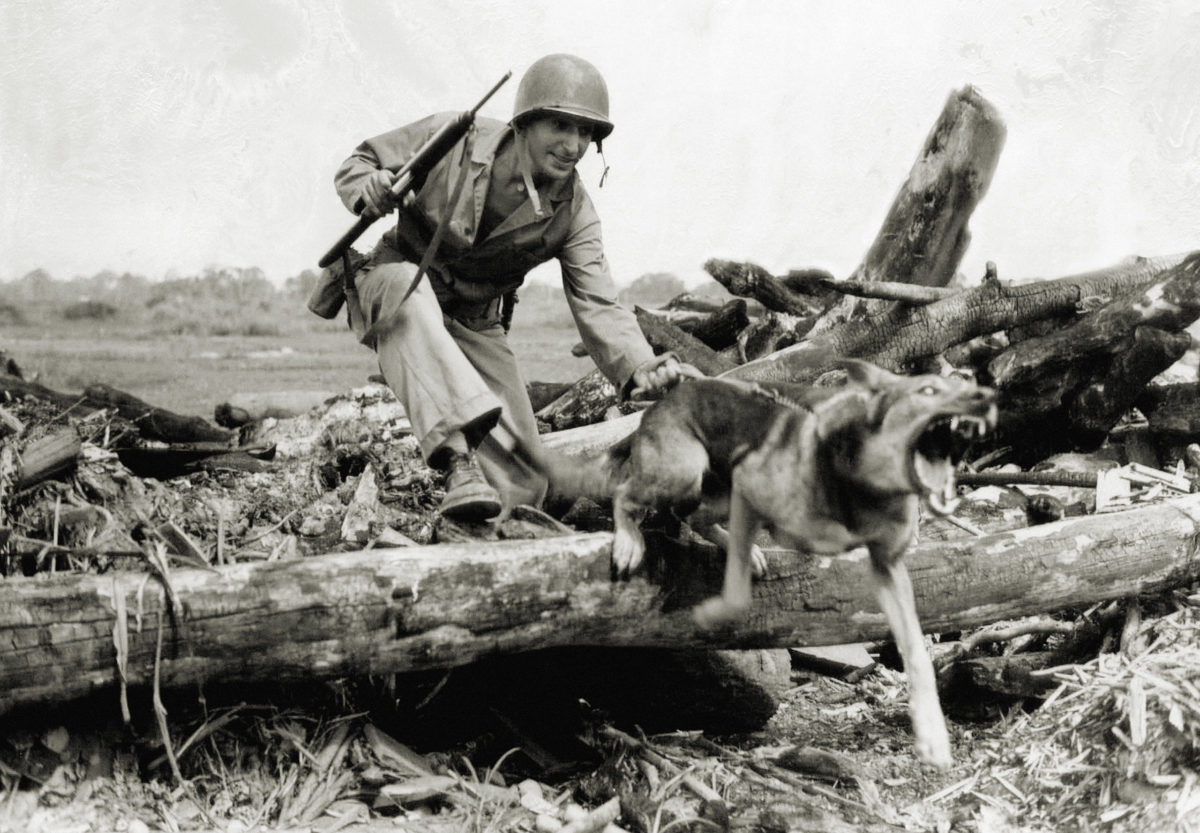
Training the Dogs in WW2
The German Army had special eight-week schools for training their dogs in WW2, beginning with testing the animals’ potential at age six months. For this early examination, the weeding out process required the potential doggy recruit to follow his owner day or night across different terrain, to behave properly in climbing stairs, in going into a darkened room, in crossing ditches and streams, on hearing gunfire, and more. Timid dogs were instantly eliminated from the program.
The Allies had similar initial testing and found that gun shyness alone washed out roughly a third of the potential war dogs right from the beginning. The standard American and British dog training programs were usually of six to eight weeks’ duration for sentry dogs, but for those performing more specialized missions training could last up to 12 weeks.
American Army war dogs fell under the auspices of the Quartermaster Services, and their special niche became known as the K-9 Corps. Schools were set up around the country for training courses. Of course, the Army produced a manual on the subject: Technical Manual; TM 10-396, War Dogs, 1 July 1943.
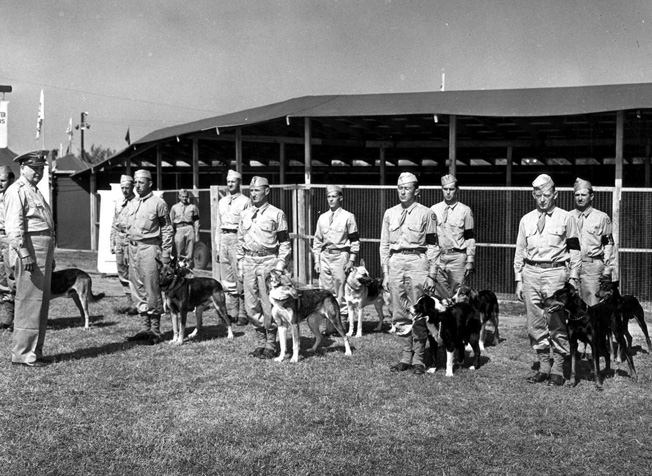
The British dogs belonged to the Royal Army Veterinary Corps, which had an excellent source of practical knowledge to draw upon when it came to training their war dogs, the Royal Canadian Mounted Police. The famous Mounties in their isolated and far-flung posts had trained and worked with canines in conjunction with their police duties for many years before the war in an era when police dogs were otherwise unheard of.
Like their charges, dog handlers were also specially selected from men who had finished their basic military training. A solid prerequisite was for men who were both friendly and sympathetic to dogs; a dog sensed handlers who were not, and the animal’s willingness to perform greatly declined. German schools called for Hundefreunde—dog lovers—and spent approximately as much time on training the handlers as they did the dogs.
Soviet Dog Mines Against German Tanks
The strangest and most gruesome use of war dogs came on the Eastern Front. In early 1942, Operation Barbarossa found the Soviets hard-pressed. They had lost vast numbers of tanks and antitank weapons in 1941, their industries were in the process of relocating to the Urals, and they were desperate for anything to stop the German panzers. Enter the dog mine; dogs were trained to run under enemy tanks with anti-tank mines attached to their backs.
Dogs were fitted with a canvas body harness rather like a version of the modern dog backpacks. To the harness was attached to either a wooden box or packets of high explosive, as much as 25 pounds. A wooden dowel known as a tilt rod detonator protruded upward from the dog’s back to trigger the explosives when it crawled beneath a panzer, in theory destroying the tank with a blast to the thin bottom armor. This method was, obviously, a single-shot weapon.
The idea may have looked good on paper, except to the poor dogs, but it left something to be desired when put into practice in combat.
Training involved feeding the dogs beneath tanks. However, the smells, sounds, and sights of a Soviet tank were quite different from those of a German tank. In the fog of war, with explosions and bullets flying, it was not unrealistic for the dogs to become confused or panicked. They were just as likely to run under a friendly tank as an enemy tank. Additionally, once the German Army learned of the Hundminen the intelligence was quickly disseminated throughout the front and orders were given to shoot all dogs on sight. While there were a few successes, the idea was short-lived indeed, although it was reported that the Viet Minh later attempted to use dog mines against French vehicles in Indochina.
HISTORIC WORLD LEADERS AS DOG BREEDS #history #ww2 #dog #dogs #animals #comedy #wwii
FAQ
Were there dogs in World War II?
Some twenty thousand dogs served the U.S. Army, Coast Guard, and Marine Corps. They guarded posts and supplies, carried messages, and rescued downed pilots.
Did they strap bombs to dogs in WWII?
The dogs were trained to run under German tanks with mines strapped to their backs, blowing themselves up and taking the vehicles with them.
When did they start using dogs in war?
Were dogs used in WW1?