
Does your furry friend hide during thunderstorms? Start trembling when visitors arrive? Or maybe they destroy your house when you leave? If you’re nodding along you’re probably dealing with an anxious dog.
I’ve been there. My rescue pup, Bailey, used to practically vibrate with anxiety whenever I grabbed my car keys. It broke my heart to see her so stressed, and I bet you feel the same way about your nervous pooch.
The good news? You CAN help your anxious dog feel better. After tons of research and personal trial-and-error, I’ve put together this comprehensive guide on how to help an anxious dog. Let’s jump right in!
Understanding Dog Anxiety: What’s Going On Inside Your Pup’s Head?
Before we dive into solutions it’s important to understand what anxiety actually looks like in dogs. According to the American Kennel Club (AKC) anxiety in dogs is quite common and manifests in various ways.
Common Signs Your Dog Might Be Anxious:
- Physical signs: Panting, drooling, shaking, whites of eyes showing
- Behavioral signs: Excessive barking, whining, destructive behavior, house soiling
- Body language: Ears pulled back, licking lips, pacing, restlessness
- Other symptoms: Aggression, depression, repetitive behaviors
My dog Bailey would tremble, pant, and follow me from room to room whenever she sensed I was about to leave. Your dog might show different symptoms – each pup expresses anxiety in their own way.
Main Types of Anxiety in Dogs
According to veterinary experts there are three main types of anxiety that affect dogs
- Fear-related anxiety: Triggered by loud noises, strange people/animals, new environments, specific situations (vet visits, car rides)
- Separation anxiety: Occurs when dogs are left alone or separated from family members (affects around 14% of dogs!)
- Age-related anxiety: Commonly affects older dogs, often linked to cognitive dysfunction syndrome (similar to early Alzheimer’s in humans)
12 Effective Ways to Help Your Anxious Dog
Now for the strategies that can actually help your anxious pup feel better:
1. Create Distance From Triggers
When your dog shows signs of anxiety, the quickest way to help them calm down is to move them away from whatever’s causing stress. This works for both fear and excitement-based behaviors.
Dr. Katherine Houpt, professor emeritus at Cornell University, explains that forcing your dog closer to a trigger will only increase their stress levels. Instead, putting distance between your dog and what’s scaring them helps them calm down more quickly.
2. Establish a Predictable Routine
“What seems to work best is predictability,” says Dr. Houpt. “If dog does X, then Y happens. It sounds simplistic, but it really seems to help dogs know what happens when.”
I’ve found with Bailey that scheduling her meals, walks, playtime and training sessions at consistent times makes a huge difference. Even something as simple as asking your dog to sit before meals gives them a sense of control and predictability.
3. Create a Safe Space
Dogs need a secure retreat when they’re feeling overwhelmed. This could be a crate, a specific room, or just a cozy corner with their favorite bed.
For my anxious pup, I set up what we call her “happy place” – a quiet corner with her bed, favorite toys, and a blanket that smells like me. When fireworks start or when guests arrive, she knows she can retreat there.
Make sure your dog has positive associations with this space – never use it for punishment!
4. Try Gentle Touch and Massage
Slow, gentle petting can help calm an anxious dog. Fast petting might excite them more, but long, smooth strokes can be soothing. Ashley Dalton, a dog trainer with Zoom Room, recommends watching your dog’s body language to see if they’re comfortable with being touched, as not all dogs enjoy it when anxious.
5. Modify Your Voice and Breathing
Dogs are incredibly sensitive to our tone and energy. When your dog is anxious:
- Speak in a low, slow, calm voice
- Keep your volume down
- Take deep, slow breaths (dogs can pick up on your breathing patterns!)
I’ve noticed that when I get frustrated with Bailey’s anxiety, it only makes things worse. Taking a deep breath and speaking calmly helps both of us!
6. Use Calming Music
Studies show that soft music, especially classical music, can help dogs relax. Some streaming services even have playlists created specifically for calming dogs!
Just avoid heavy rock or metal music, as these might make some dogs more anxious. If your dog has noise reactivity, they may not respond well to music therapy.
7. Provide Physical Exercise
A tired dog is often a calmer dog! Regular exercise helps reduce anxiety by:
- Burning excess energy
- Releasing endorphins (feel-good hormones)
- Providing mental stimulation
However, be careful not to overdo it. Too much intense exercise like running or playing fetch might actually make some dogs more anxious. Keep it balanced with gentle walks and playtime.
8. Try Distraction Techniques
If your dog isn’t too anxious to eat, using treats or toys can help distract them from whatever is making them nervous. This technique won’t change how they feel about the trigger, but it might help them feel a little less worried in the moment.
Training games like “Look At That” and “Find It” can be particularly effective. For these games, you start by rewarding your dog for acknowledging a trigger, then gradually shift to rewarding them when they look at you instead.
9. Practice Desensitization and Counterconditioning
This is a more advanced strategy that takes time but produces lasting results. The basic idea:
- Gradually expose your dog to a mild version of what scares them
- Pair this exposure with something positive (usually treats)
- Slowly increase exposure while maintaining the positive association
For example, if your dog is afraid of thunderstorms, you might start by playing very quiet thunder sounds while giving treats, then gradually increase the volume over many sessions.
10. Consider Professional Training
If your dog’s anxiety is severe or not improving with home methods, consider working with a professional. Look for a certified dog trainer who specializes in anxiety and uses positive reinforcement methods.
Avoid trainers who use harsh or punitive methods like yelling, leash jerking, or shock collars. These approaches can actually make anxiety worse!
11. Explore Calming Products
There are many products designed to help anxious dogs:
- Calming beds and blankets
- Thundershirts or anxiety wraps
- Pheromone diffusers (like Adaptil)
- Calming treats or supplements
These products might work for some dogs but not others, so you may need to experiment to find what helps your specific pup.
12. Discuss Medication With Your Vet
For severe anxiety, medication might be appropriate. Common medications for dog anxiety include:
- Fluoxetine (Reconcil)
- Clomipramine (Clomicalm)
- Trazodone
- Dexmedetomidine (Sileo)
Dr. Houpt says that if you or your dog are suffering, or if your relationship with your dog is suffering, then anti-anxiety medications are a solid option. Never try to medicate your dog without veterinary guidance!
Common Mistakes to Avoid
When trying to help an anxious dog, there are a few approaches that can actually make things worse:
- Punishing your dog for anxious behavior – This increases fear and damages trust
- Forcing exposure (flooding) – Keeping your dog in a scary situation without helping them cope can make anxiety worse
- Focusing only on obedience – Anxiety isn’t a training issue; it’s an emotional one
- Using “quick fix” solutions – Real improvement takes time and patience
- Comforting with high-pitched “baby talk” – This can actually reinforce anxious behavior
When to Seek Professional Help
You should consult with your veterinarian if:
- Your dog’s anxiety is severe or getting worse
- Their anxiety leads to aggressive behavior
- Your dog is hurting themselves
- Home management strategies aren’t working
- You’re feeling overwhelmed by your dog’s anxiety
Your vet can rule out medical causes and might refer you to a veterinary behaviorist for specialized help.
Prevention is Better Than Cure
If you have a new puppy or are planning to get one, here are some ways to help prevent anxiety from developing:
- Early socialization: Expose your puppy to different people, animals, environments, and experiences
- Positive experiences: Make new encounters fun and rewarding
- Gradual independence: Teach your puppy to be comfortable alone for short periods
- Basic obedience: Training builds confidence and communication
- Regular exercise and mental stimulation: Keeps your dog physically and mentally healthy
My Personal Experience
I’ve tried pretty much everything on this list with my anxious rescue, Bailey. What worked best for us was a combination of:
- Creating a consistent daily routine
- Setting up a safe space with her favorite things
- Using calming music during thunderstorms
- Working with a positive reinforcement trainer
- Short-term medication during the most stressful times (like July 4th)
It wasn’t an overnight fix – it took months of patience and consistent work. But seeing Bailey transform from a trembling, destructive mess to a mostly-confident dog who can handle being alone for a few hours has been incredibly rewarding.
Final Thoughts
Helping an anxious dog requires patience, consistency, and understanding. There’s no one-size-fits-all solution, so you’ll likely need to try different approaches to see what works best for your unique pup.
Remember that anxiety isn’t something your dog chooses – they’re genuinely distressed and need your compassionate support. With time and the right approach, most anxious dogs can learn to feel safer and more confident.
Has your dog struggled with anxiety? What strategies have worked best for you? Share your experiences in the comments below!
Anxiety in dogs is seldom a simple diagnosis
If your dog is nervous, and maybe even somewhat fearful at times, it’s wise to look deeply into what may be causing these behavioral issues and then devise a plan to help your dog become more confident. An anxious dog is an unhappy dog. You can change that by adding consistency and predictability to your dog’s life.
- Destructive behaviors
- Drooling
- Ears pulled down or back
- Excessive barking
- Licking lips
- Panting
- Shaking
- Whining
- Whites of the eyes showing
“In my experience, anxiety is used as a blanket description for anything that the dog does that the owner doesn’t like,” says Dr. Katherine Houpt, the James Law Professor Emeritus of Behavior Medicine in the Department of Clinical Sciences.
Houpt says she almost never diagnoses anxiety by itself. Instead, there is usually something else behind a dogs anxious behavior.
Dogs can exhibit anxiety through a wide range of behavior problems, including:
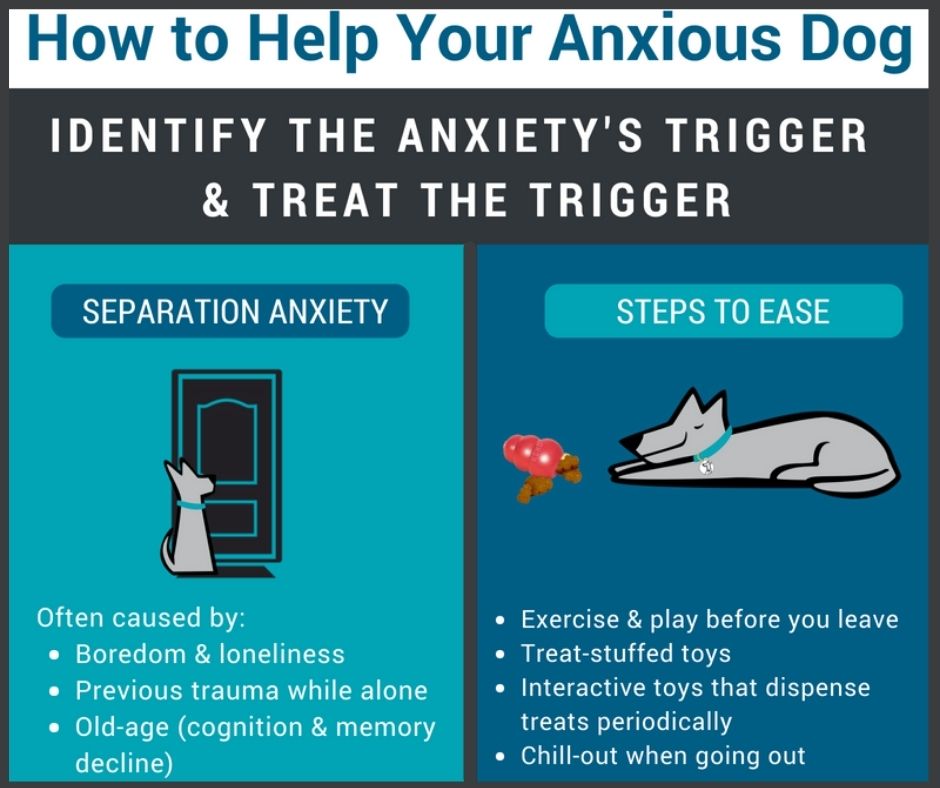
The dog shows signs of distress, such as whining, howling, barking, pacing, house soiling or destroying household items after their owner leaves. While at home, dogs with separation anxiety often prefer to be in the same room as their owners, and they start becoming stressed when they see their owner preparing to go out.
The dog growls, postures, threatens or actually bites when another dog or a human tries to approach or when they try to touch something that the dog considers valuable. Resources that are typically guarded include food, treats and toys, but dogs can also show resource guarding over a preferred resting spot or their favorite person. Resource guarding can be genetic, and it can also be a learned behavior — usually due to having to defend scarce or necessary resources from other dogs.
The dog lunges, growls or snaps at people and dogs who come near their territory. This behavior is usually displayed along fence lines, through windows and at doors. These dogs may still exhibit good behavior when visiting someone else’s home or walking in an unfamiliar neighborhood, but then they bark and lunge at anyone who comes near their own house or walks past on the street.
The dog reacts fearfully to loud, high-pitched or unusual sounds. Individual dogs may find different sounds scary, and these can include the noise of objects falling, phones beeping or ringing, cars idling, noisy traffic, and more. While most dogs might be startled by an unexpected sound and then move on, a sound-sensitive dog does not recover from that initial reaction, and they will continue to show signs of distress.
The dog paces and pants, particularly at night, and they are often restless, not wanting to settle. They may also seem disoriented. CDS usually affects senior dogs, as a result of age-related changes in the brain.
Behavioral modification is critical to managing anxiety, but the exact strategy depends on the cause of the anxiety, as well as any other behavioral issues that are present.
For example, if you own multiple dogs and one starts to exhibit resource guarding by preventing your other dogs (or even other pets) from approaching you, then you could start by keeping the animals separate and giving them each equal one-on-one time with you. Gradually, over time, you can start doing some activities with the dogs together again.
If your dog has separation anxiety, you can gradually desensitize them to being left alone. Start by first just walking out of the room and immediately coming back; then gradually increase the amount of time that you are out of sight.
Don’t expect a quick fix. An experienced, fear-free dog trainer who offers classes for you and your dog can be an excellent place to start. Good dog trainers use positive reinforcement to encourage the desired behaviors. Avoid trainers who use harsh, punitive methods such as yelling, jerking leashes, pinch collars, shock collars and so on. Be wary of any trainers who offer a quick fix.
- Fluoxetine (Reconcil)
- Clomipramine (Clomicalm)
- Trazadone
- Dexmedetomidine (Sileo)
Houpt says that if you think the dog is suffering, if you are suffering or if your relationship with the dog is suffering, then anti-anxiety medications are a solid option. In her experience, by the time most owners resort to seeing a behaviorist, their dogs need medication.
Medications might only be necessary while youre working on behavioral modification strategies, or they may be beneficial for the rest of your dog’s life. Rather than picking up an over-the-counter supplement or another other remedy from the Internet, schedule a visit with your veterinarian.
Remember that with or without medications, it is still essential to develop a routine for your dog to help give them a more predictable, happy life.
How To Build Confidence & Reduce Anxiety In Fearful and Anxious Dogs
FAQ
How to train a dog to calm anxiety?
What is the 3-3-3 rule for dog anxiety?
The 3-3-3 rule for dogs is a guideline outlining the typical adjustment period for a rescue dog after adoption, broken into three phases: 3 days of feeling overwhelmed and nervous, 3 weeks of settling into a routine and showing their personality, and 3 months of feeling truly at home, trusting, and bonding with their new family. This rule provides a helpful framework for new owners to set realistic expectations and be patient, as the timeline can vary for each dog.
Why is my dog so anxious all of a sudden?
A sudden onset of anxiety in a dog points to a potential underlying medical issue, so the first and most important step is to schedule a visit with your veterinarian to rule out illness, pain, or age-related cognitive decline. If no medical problem is found, other causes for sudden anxiety can include recent changes in household routines, a traumatic experience, new unfamiliar environments or people, or loud noises. Your veterinarian can help determine the cause and develop a treatment plan, which may involve medication, behavioral modification, or environmental adjustments.
What not to do with dog separation anxiety?
When dealing with a dog’s separation anxiety, do not punish or scold your dog, as their anxious behavior is not disobedient or spiteful but a stress response. Avoid using devices like shock or vibrating collars, as they can worsen fear and anxiety. Do not suddenly leave your dog alone for long periods, as this can heighten anxiety; instead, gradually increase separation duration. Also, refrain from getting another pet to solve the problem, as the anxiety is about separation from you, and avoid crating if your dog may injure themselves trying to escape.