
“Do dogs have knees?” is a fairly common question among dog parents. The short answer is—yes! But we don’t plan to stop there. Integrative veterinarian Dr. Julie Buzby dives into canine anatomy to answer that question in more detail and explains some common knee problems in dogs.
You’ve probably seen entertaining photos of dog parents who resemble their dogs. Dogs and their humans do share a lot in common! Of course, dogs are obviously built differently than we are, but we do share some anatomical traits.
Which brings me to a couple of questions that I get a lot from curious dog parents about their pups’ bodies: “Do dogs have knees?” and “Do dogs have knee caps?”
In short, yes, dogs do have knees. They have two knees, two knee caps, two elbows, two wrists – just like us! Let’s take a look at some canine anatomy.
Have you ever looked at your furry friend and wondered about their leg structure? The way they move, run, and jump is fascinating, but it might leave you pondering – do dogs have elbows or knees? This isn’t as straightforward as it might seem! Let’s dive into the world of canine anatomy and discover the truth about our four-legged companions’ limbs.
The Short Answer: Yes, Dogs Have Both!
First things first – dogs actually have both elbows AND knees. That’s right! Just like us humans, our canine companions have these important joints that help them move around. However, there are some key differences in terminology and positioning that can cause confusion.
Dog Leg Anatomy 101: Front Legs vs. Back Legs
Let’s break down a dog’s leg anatomy in simple terms:
Front Legs (Forelegs)
- Elbows: Dogs have elbows in their front legs (also called forelegs)
- The front leg contains bones called the radius and ulna (just like humans!)
- The joint between the humerus and the radius/ulna is the cubital joint or what we commonly call the elbow
- Below the elbow is the carpus, which is equivalent to our wrist
Back Legs (Hind Legs)
- Knees: Dogs have knees in their hind legs
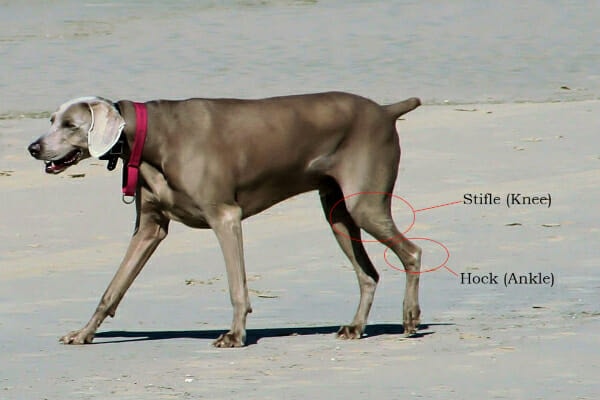
- The technical term for a dog’s knee is the stifle joint
- The stifle joint connects the femur (thigh bone) to the tibia and fibula (lower leg bones)
- Dogs also have a patella (kneecap) just like humans
- The hock joint in the back leg is equivalent to our ankle (not a knee!)
Common Misconceptions About Dog Legs
One of the biggest confusions about dog anatomy is thinking that dogs have “backward knees” in their hind legs This is actually not true! What looks like a backward knee is actually the dog’s hock joint – which is more like our ankle
Dogs, like all four-legged mammals, have:
- Two knees (in the back legs)
- Two elbows (in the front legs)
That part that bends “the wrong way” in the back leg? That’s the ankle equivalent, not a backward knee!
Visual Comparison: Dog vs. Human Limbs
To really understand this concept, imagine a dog standing on all fours. Now, if a human were to get down on all fours:
- Our hands would correspond to a dog’s front paws
- Our elbows would be in roughly the same position as dog elbows
- Our knees would match up with dog knees
- Our ankles would be in the position of the dog’s hock joints
The difference is that dogs walk on their toes (they’re digitigrade), while we walk on our whole foot (we’re plantigrade).
Important Joints in Dog Legs and Common Issues
Stifle Joint (Knee)
The stifle joint is prone to several issues including:
- CCL tears: Dogs don’t have ACLs like humans; they have cranial cruciate ligaments (CCLs)
- Luxating patella: This happens when the kneecap dislocates from its normal position (common in small breeds)
Hock Joint (Ankle)
The hock connects the shin bones to the paw bones in the hind leg and can suffer from:
- Sprains and strains
- Arthritis in older dogs
Elbow Joint
Common elbow issues include:
- Elbow dysplasia
- Arthritis
- Fractures
Carpus (Wrist)
The wrist can suffer from:
- Sprains
- Hyperextension injuries
- Arthritis
7 Trends in Canine Joint Health and Awareness
-
Increased Awareness of Canine Anatomy: Pet owners are becoming more educated about their dogs’ physical structure.
-
Growing Interest in Pet Health: There’s a rising trend in understanding preventative care for dog joints.
-
Rise in Pet Physical Therapy: More dogs are receiving physical therapy for joint issues than ever before.
-
Emphasis on Preventative Care: Regular vet visits and early intervention are becoming the norm.
-
Increased Demand for Joint Supplements: Products containing glucosamine, chondroitin, and omega-3s are popular.
-
Rise in Canine Fitness Classes: Structured exercise programs designed specifically for dog joint health.
-
Growth in Orthopedic Veterinary Services: More specialized care is available for dogs with joint issues.
How to Spot Potential Joint Problems in Your Dog
Keep an eye out for these warning signs of joint issues:
- Limping on front or back legs
- Limping that worsens after rest or exercise
- Weakness in legs
- Swelling around joints
- Reluctance to put weight on a leg
- Excessive licking at knee or paw area
- Intermittent hopping in gait
- Difficulty getting up or lying down
- Decreased activity or reluctance to jump, run or climb stairs
Keeping Your Dog’s Joints Healthy
Daily Maintenance
- Maintain a healthy weight (excess weight puts strain on joints)
- Provide regular, appropriate exercise
- Use ramps for older dogs to avoid jumping
- Provide a comfortable orthopedic bed
Dietary Support
- Feed a balanced, high-quality diet
- Consider joint supplements (with vet approval)
- Ensure adequate omega-3 fatty acids
Regular Vet Care
- Schedule regular check-ups
- Discuss any mobility changes with your vet
- Consider x-rays for at-risk breeds
FAQ: Common Questions About Dog Joints
Q: Do all four-legged animals have knees and elbows?
A: Yes! All four-legged mammals have two knees (back legs) and two elbows (front legs).
Q: Is it true that elephants are the only animals with four knees?
A: No, this is a myth. Elephants, like all four-legged mammals, have two knees and two elbows.
Q: Do dogs have kneecaps?
A: Yes, dogs have patellas (kneecaps) just like humans do.
Q: Why does my small dog sometimes skip or hold up a back leg?
A: Small breeds can experience luxating patellas (kneecap slips out of place). Often, it resolves on its own, but consult your vet if it happens frequently.
Q: Do dogs have armpits?
A: Since dogs have front legs that correspond to human arms, they do have armpits in their front legs.
Q: Can dogs tear their ACL like humans?
A: Dogs have a CCL (cranial cruciate ligament) rather than an ACL, but yes, they can tear this ligament which causes similar symptoms to a human ACL tear.
Q: What’s the difference between how dogs and humans walk?
A: Humans walk on our heels and full foot (plantigrade), while dogs actually walk on their toes (digitigrade).
When to See a Vet About Joint Issues
You should consult your veterinarian if your dog shows:
- Persistent limping for more than 24 hours
- Obvious pain when touching a limb
- Swelling or heat in a joint
- Reluctance to bear weight on a limb
- Changes in gait or mobility
Treatment Options for Dog Joint Problems
Conservative Management
- Rest and restricted activity
- Physical therapy and rehabilitation
- Weight management
- Anti-inflammatory medications
- Joint supplements
Supportive Devices
- Braces for knees or hocks
- Orthotics for wrists
- Harnesses to assist with mobility
Surgical Options
- CCL repair or reconstruction
- Luxating patella correction
- Joint replacement surgery
- Arthroscopy
Conclusion
So there you have it – dogs definitely have both elbows AND knees! Their anatomy is similar to ours in many ways, but with some key differences that reflect their four-legged lifestyle. Understanding your dog’s joint structure can help you better care for them and recognize when something might be wrong.
As a responsible pet owner, keeping an eye on your dog’s mobility and joint health is essential. Regular vet check-ups, appropriate exercise, and good nutrition will go a long way in maintaining healthy joints throughout your dog’s life.
Remember – if your furry friend shows signs of joint pain or mobility issues, don’t hesitate to contact your vet. Early intervention can make a world of difference in managing joint problems and keeping your canine companion happy and active!
References
- Veterinary anatomical resources
- Canine physical therapy guidelines
- Orthopedic veterinary medicine
Have you ever noticed your dog limping or showing signs of joint discomfort? Share your experiences and questions in the comments below!

What are some common knee problems in dogs?
Unfortunately, knee issues in dogs are quite common. There are two broad categories these problems typically fall under—congenital issues (i.e. those present from birth) and knee injuries.
Medial patellar luxation (MPL) is typically a congenital issue that primarily affects small and toy breed dogs, such as Yorkies, Pomeranians, Chihuahuas, etc. In this condition, the kneecap slips out of place toward the inside of the leg. It may or may not spontaneously correct depending on the severity of the condition. Patellar luxation most commonly presents as dogs “skipping a step” or intermittently holding up the affected leg(s) when walking or running.
Dogs can also suffer from lateral patellar luxation (LPL) where the kneecap moves to the outside of the leg. This is more often the result of an injury rather than being a congenital issue like MPL.
Your veterinarian can diagnose a patellar luxation based on the physical exam and imaging such as an X-ray. Depending on the severity, your veterinarian may recommend medical or surgical treatment.
A CCL tear (otherwise known as a torn ACL in dogs) is one of the most common orthopedic injuries I see. It typically happens in larger breed dogs such as Labs, German Shepherds, and Pit Bulls. They may have a partial or full tear. You may have heard of athletes suffering from ACL tears—this is the same injury for dogs.
However, it doesn’t always happen in exactly the same manner. Athletes tend to rupture their ACL suddenly. On the other hand, dogs may have hidden degeneration of the CCL that predisposes it to rupture. As such, it may look like the dog acutely tore the CCL running, jumping, playing fetch, etc. but in reality the stage had been set for that injury for a long time.

Similar to patellar luxation, the veterinarian can usually diagnose a CCL tear with physical exam, the drawer test, and X-rays or other imaging. Treatment may depend on the individual dog’s situation, but typically a surgical procedure such as TPLO surgery for dogs gives the best outcome.
Just like people, dogs can have tears in their menisci from trauma of some sort. Landing wrong after jumping up to catch a frisbee may be enough to damage the sensitive knee cartilage. Meniscal tears are also very commonly associated with CCL tears. Cartilage is very difficult to assess on X-rays, so advanced imaging like MRI or arthroscopy in dogs (scoping the joint with a small camera under anesthesia) may be necessary to make a diagnosis. The veterinarian may recommend medical or surgical treatment for meniscal tears.
The collateral ligaments on the sides of the knee can be injured as well. However, this type of injury is far less common than a CCL tear. It could result from an injury such as another dog crashing into a dog’s knee during play. Additionally, the collateral ligament could tear due to significant trauma to the knee (i.e. a fall, dog fight, or being hit by a car). In these cases, the damage often involves several knee structures.
As with the other orthopedic problems, the veterinarian can often diagnose a collateral ligament tear on a physical exam and imaging. Treatment depends on the severity and effect of the tear but may involve medical or surgical therapy.
Just like any other bones, the bones of the knee can also break. Outside of an underlying health issue such as a bone tumor, this would require significant trauma. Your veterinarian can diagnose a fracture on X-rays. Due to the location, a cast or splint is rarely effective. Thus, surgical repair is typically the treatment of choice.
The ligaments of the knee
Inside the knee joint are two very important ligaments that criss-cross between the femur and tibia called the cruciate ligaments. In humans, these are referred to as the anterior cruciate ligament (ACL) and posterior cruciate ligament (PCL). Since we stand upright, our anatomical directional terms are slightly different than the ones we use for dogs.
As such, these same structures in dogs’ legs are called the cranial cruciate ligament (CCL or CrCL) and caudal cruciate ligament (CaCL). These ligaments stabilize the knee to prevent the tibia from moving forward and backward in relation to the femur. “Drawer” is the term for this movement. You may have heard of a drawer sign test. It is the way veterinarians and physicians assess the integrity of the cruciate ligaments.
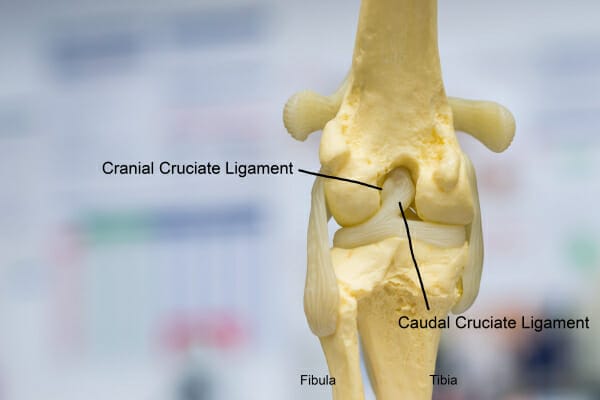
The medial and lateral collateral ligaments run down the sides of the knee. They stabilize the joint from the outside, preventing too much sideways movement, and keeping the hinge function of the joint on track.