
I’ve always been fascinated by wolfdogs – those magnificent creatures that combine the wild spirit of wolves with the companionship of domestic dogs. But one question I hear constantly from potential owners and curious animal lovers is: just how big can these hybrids actually get?
The answer isn’t straightforward because wolfdogs vary tremendously in size depending on their specific wolf content and dog breed ancestry. Let me break down what you need to know about wolfdog sizes, with some eye-opening comparisons.
Understanding Wolfdog Size Basics
Wolfdogs are hybrids created by breeding domestic dogs (Canis familiaris) with gray wolves (Canis lupus), eastern wolves (Canis lycaon), red wolves (Canis rufus), or Ethiopian wolves (Canis simensis). Their size can vary dramatically based on:
- The percentage of wolf content (low, mid, or high)
- The specific dog breed used in breeding
- The generation of the hybrid
- Gender (males tend to be larger)
Average Size Ranges for Wolfdogs
Here’s what you can typically expect from a fully-grown wolfdog
| Feature | Average Wolfdog Size | Comparable To |
|---|---|---|
| Height (at shoulder) | 25-33 inches | Larger than a German Shepherd |
| Weight | 60-120+ pounds | Similar to a large Malamute or small wolf |
| Length (nose to tail) | 4-6 feet | Longer than most large dog breeds |
| Paw Size | 3-5 inches wide | Significantly larger than dog paws |
High-Content vs. Low-Content Wolfdog Size
The percentage of wolf genetics in your wolfdog dramatically affects its ultimate size
High-Content Wolfdogs (80%+ wolf)
These animals closely resemble their wild wolf ancestors in both appearance and size. They typically stand 28-33 inches at the shoulder and can weigh between 90-150 pounds. Their build tends to be leaner and more athletic than pure dogs, with longer legs, larger paws, and broader skulls.
As one wolfdog owner told me, “My high-content boy is huge – not just tall but has this presence that makes even large dogs look small beside him. His paws are literally the size of my palm!”
Mid-Content Wolfdogs (50-79% wolf)
These hybrids show a more balanced blend of wolf and dog characteristics. They usually reach 26-30 inches at the shoulder and weigh between 70-120 pounds. Their build typically remains more wolf-like than dog-like.
Low-Content Wolfdogs (1-49% wolf)
These animals display more dog-like traits in both appearance and size. They typically stand 24-28 inches at the shoulder and weigh between 60-100 pounds, though this varies widely depending on the dog breed in their ancestry.
Comparing Wolfdogs to Pure Wolves and Dogs
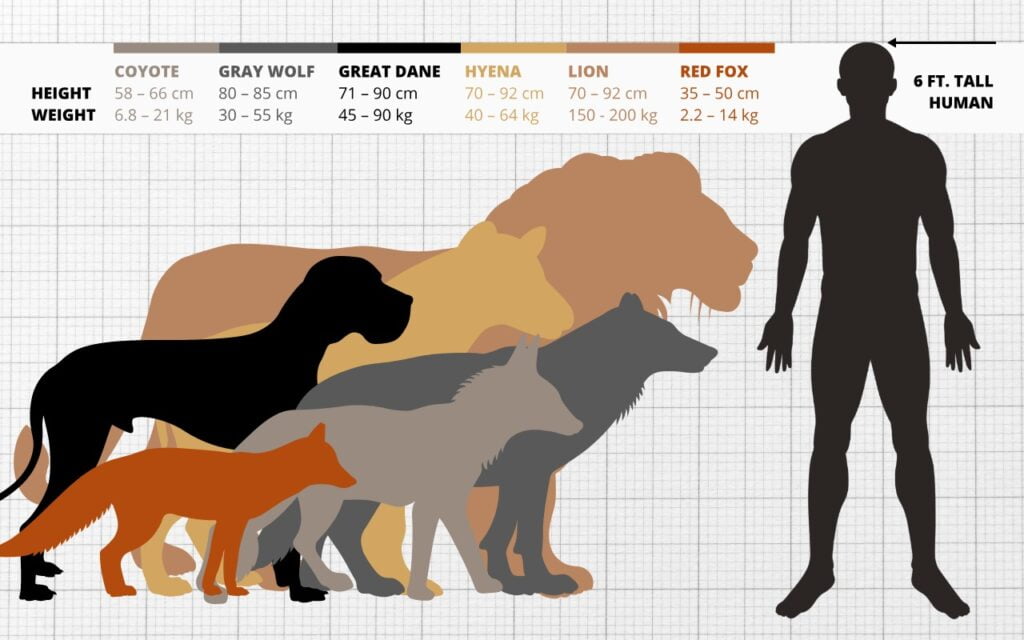
To understand just how big wolfdogs can get, it helps to compare them to both pure wolves and domestic dogs:
Wolves
- Height: 26-33 inches at shoulder
- Weight: 70-150 pounds
- Length: 4.5-6.5 feet (nose to tail)
- Paw Size: 4-5 inches wide
- Build: Lean, muscular, longer legs, narrow chest
Large Domestic Dogs (Great Danes, Irish Wolfhounds)
- Height: 28-35 inches at shoulder
- Weight: 120-200+ pounds
- Length: 4-6 feet (nose to tail)
- Paw Size: 3-4 inches wide
- Build: Often bulkier, less athletic than wolves
Medium-Large Dogs (German Shepherds, Huskies)
- Height: 20-26 inches at shoulder
- Weight: 50-90 pounds
- Length: 3-5 feet (nose to tail)
- Paw Size: 2-3 inches wide
What’s interesting is that while some large dog breeds might exceed wolves in height or weight, wolfdogs often inherit the wolf’s leaner, more athletic build rather than a stockier dog physique.
Popular Dog Breeds Used in Wolfdog Breeding
The specific dog breeds used in wolfdog breeding significantly impact the resulting hybrid’s size:
- German Shepherds: Create wolfdogs standing 24-30 inches tall, weighing 70-110 pounds
- Alaskan Malamutes: Produce larger wolfdogs, 26-32 inches tall, weighing 75-120 pounds
- Siberian Huskies: Result in slightly smaller wolfdogs, 22-28 inches tall, weighing 60-90 pounds
When I visited a wolfdog sanctuary last year, I was struck by how different the Malamute-wolf crosses looked from the Husky-wolf crosses – not just in color but in overall mass and structure!
Notable Wolfdog Breeds and Their Sizes
Some recognized wolfdog breeds have more standardized sizes:
Czechoslovakian Wolfdog
- Height: 24-26 inches (females), 26-28 inches (males)
- Weight: 44-57 pounds (females), 57-77 pounds (males)
- Recognized by the FCI, these animals were originally bred for border patrol work
Saarloos Wolfdog
- Height: 24-28 inches (females), 26-30 inches (males)
- Weight: 65-90 pounds
- Created in the Netherlands in 1932 by breeding a German Shepherd with a female European wolf
Physical Characteristics Beyond Size
It’s not just about height and weight – wolfdogs differ from pure dogs in several physical ways:
- Proportions: Longer legs relative to body length
- Chest: Narrower than many large dog breeds
- Head: Often larger with broader skulls and longer snouts
- Ears: Typically larger and more triangular than dog ears
- Feet: Significantly larger paws with longer toes
- Teeth: Larger canine teeth than comparably sized dogs
One wildlife biologist I spoke with mentioned that “the wolfdog’s physical proportions are often what give away their wolf ancestry – even when they’re not particularly large, there’s something about the way they’re built that looks different from pure dogs.”
Health and Lifespan Related to Size
Interestingly, wolfdogs are generally said to be naturally healthy animals despite their size, affected by fewer inherited diseases than many dog breeds. This is often attributed to hybrid vigor (heterosis).
However, their large size can contribute to some of the same issues that affect large dog breeds:
- Joint issues as they age
- Potential for bloat
- Heart conditions in some cases
Real-World Considerations for Potential Owners
If you’re considering a wolfdog, remember that their size comes with practical challenges:
- Space requirements: These are not apartment animals! They need substantial outdoor space.
- Containment: Tall, secure fencing (minimum 6-8 feet) is essential.
- Exercise needs: Their size and energy require significant daily exercise.
- Food costs: Feeding a 120+ pound carnivore isn’t cheap!
- Legal considerations: Many states and counties have restrictions or bans on wolfdog ownership.
Final Thoughts: Is Bigger Always Better?
While the impressive size of wolfdogs might be appealing, it’s important to remember that these aren’t just “extra-large dogs.” Their size comes with wolf behaviors, needs, and instincts that make them challenging pets for most people.
As one experienced wolfdog sanctuary owner told me, “People get fixated on how magnificent these animals look, but they don’t realize that the same genes that make them big and beautiful also make them wild. Size should be the last reason anyone considers a wolfdog.”
For those genuinely interested in these remarkable animals, I recommend visiting wolfdog sanctuaries and speaking with experienced owners before making any decisions. The size of these animals is just one small aspect of what makes them such complex and challenging companions.
Have you encountered a wolfdog in person? Were you surprised by their size? I’d love to hear about your experiences in the comments!
How old is Yuki?
Yuki is 12 years old, so when hes not enjoying one of his favorite volunteers or not being fed, he spends his time relaxing in the sun. The Giant Wolfhound seems to be living a good wolf life.
CHARACTERISTICS OF THE GIANT WOLF DOG
This giant wolfhound is about 5,4 feet and 120 pounds! He is twice as heavy and twice as big as an ordinary wolf dog. “Yuki is the largest animal at the shelter and one of the largest wolf dog in the world” the officials said.
They went to pet a wolf thinking it was a dog
FAQ
How tall can wolf dogs get?
Wolfdog height varies significantly based on breed, lineage, and sex, but generally falls between 24 and 32 inches at the shoulder, with males typically being taller and heavier than females. For example, a male Saarloos Wolfdog can reach 26–30 inches, while a female Czechoslovakian Wolfdog might be 24–26 inches at the shoulder.
What is the largest wolfdog?
1. How big is Yuki the giant wolf dog? This giant wolfhound is about 5,4 feet and 120 pounds!
Do wolf dogs make good pets?
Are wolfdogs legal in the US?