
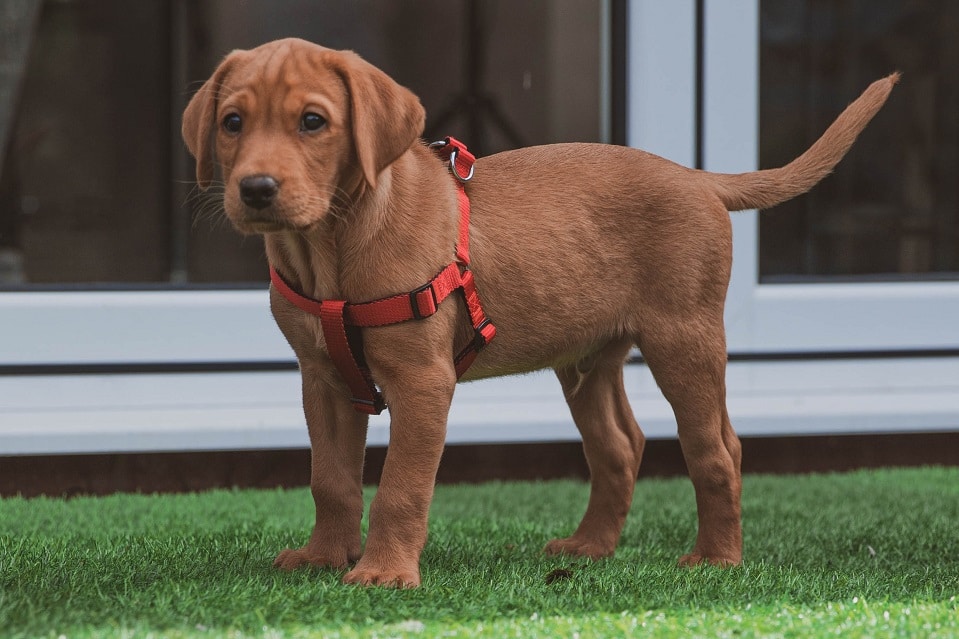
Finding the right harness for your Labrador puppy can be confusing. Too small and it might restrict their movement or hurt them; too large and they might escape during walks. I’ve been through this struggle with my own Lab puppy and trust me getting the right size makes all the difference for both you and your furry friend.
Labrador Puppy Growth and Harness Sizing
Labrador puppies grow incredibly fast, which means you’ll likely need multiple harnesses during their first year. According to the size chart by age, here’s what you can expect:
| Age | Height | Weight | Typical Harness Size |
|---|---|---|---|
| 8 weeks | 8-12 inches | 8-12 pounds | XS or S |
| 9 weeks | 8-12 inches | 10-14 pounds | XS or S |
| 10 weeks | 10-12 inches | 12-18 pounds | S |
| 11 weeks | 10-12 inches | 14-19 pounds | S |
As your Lab puppy continues to grow, they’ll eventually need a medium-sized harness around 4-5 months, and will likely graduate to a large size when they reach about 8 months of age
Why Choose a Harness Over a Collar for Your Lab Puppy?
There are several important reasons to use a harness rather than a collar for your Labrador puppy
- Prevents injuries: Harnesses distribute pressure across your puppy’s chest and shoulders instead of concentrating it on their delicate neck
- Room for growth: Harnesses provide more space for adjustments as your puppy grows
- Better control: You can guide your puppy more effectively without causing discomfort
- Reduces pulling: A good harness can help discourage pulling behaviors
- Safer for active puppies: Labs are energetic and may suddenly lunge or pull, which can cause neck injuries with collars
How to Measure Your Lab Puppy for a Harness
Getting the right measurements is crucial for finding the perfect harness. Here’s how to do it:
Measuring Girth
The most important measurement for a dog harness is the girth – the circumference around your puppy’s chest at its widest point.
- Take a flexible measuring tape
- Measure from just behind your puppy’s shoulders (the withers)
- Wrap the tape around the deepest part of the chest (usually just behind the elbows)
- Make sure the tape is snug but not tight
- Record this measurement in inches
Weighing Your Puppy
Most harness size charts also include weight ranges. To weigh your Lab puppy:
- Weigh yourself on a bathroom scale
- Pick up your puppy and weigh yourself again while holding them
- Subtract your weight from the combined weight
- This gives you your puppy’s weight
For very small puppies, you might be able to use a kitchen scale, but most Lab puppies will be too big for this even at 8 weeks.
What Size Harness for Different Lab Puppy Ages
Based on the typical growth pattern of Labrador puppies, here’s a general guide to harness sizes by age:
- 8-12 weeks: Extra-small (XS) or Small (S) – depending on your puppy’s specific measurements
- 3-4 months: Small (S) or Medium (M)
- 5-7 months: Medium (M)
- 8+ months: Large (L)
Remember that these are just guidelines! Always measure your specific puppy before purchasing a harness.
How to Tell if a Harness Fits Properly
A properly fitting harness is crucial for your Lab puppy’s comfort and safety. Here’s how to check:
Signs the harness is too small:
- You can’t fit two fingers between the harness and your puppy’s body
- The harness leaves marks on your puppy’s skin or fur
- Your puppy shows signs of discomfort like chafing or resisting the harness
- The straps dig into your puppy’s skin
Signs the harness is too big:
- Your puppy can slip out of it, especially when backing up
- There’s excessive movement of the harness when your puppy walks
- You can fit more than two fingers between the harness and your puppy’s body
- The harness twists or shifts to one side
The “two-finger rule” is a reliable way to check: you should be able to slip two fingers between any part of the harness and your puppy’s body – no more, no less.
Recommended Harnesses for Lab Puppies
Based on my experience and research, these are two excellent options for Labrador puppies:
-
PetSafe Deluxe Easy Walk Harness
- Features 4 adjustment points for a custom fit
- Padded surfaces for extra comfort
- Front chest leash attachment helps prevent pulling
- Designed to fit small through large sizes as your puppy grows
-
Kurgo Tru-Fit Harness with Seatbelt
- Includes 5 adjustment points for a perfect fit
- Front D-ring provides better control
- Broad, padded chest plate for comfort
- Compatible with most car seat belt systems for safe travel
- Comes with a lifetime warranty
Harness Size Chart for Labrador Puppies and Adult Labs
Using the comprehensive harness size chart from PawSafe and PetSmart, here’s what you can expect for Labs:
| Size | Weight Range | Girth Measurement | Typical Lab Stage |
|---|---|---|---|
| XS | 0-18 lbs (0-8 kg) | 9-15″ | Early puppyhood (8-10 weeks) |
| S | 18-35 lbs (8-15 kg) | 13-23″ | Puppyhood (10 weeks-4 months) |
| M | 30-50 lbs (13-25 kg) | 18-29″ | Adolescence (4-7 months) |
| L | 45-80 lbs (20-35 kg) | 22-39″ | Young adult to adult (8+ months) |
Labrador Retrievers typically fall into the Large category when fully grown, with most adult Labs weighing between 55-75 lbs and having a girth measurement of 22-39 inches.
When to Size Up Your Lab Puppy’s Harness
Labrador puppies grow fast, so you’ll need to check the fit of their harness regularly. Here are some signs it’s time to size up:
- The harness is on its maximum adjustment setting
- You can no longer fit two fingers between the harness and your puppy
- You notice any redness, chafing, or hair loss where the harness sits
- Your puppy seems uncomfortable or resistant to wearing the harness
- The harness leaves marks on your puppy’s fur after removal
I usually check my Lab puppy’s harness fit every 2-3 weeks during the rapid growth phase (2-6 months) and then monthly after that.
Tips for Introducing a Harness to Your Lab Puppy
Getting your puppy comfortable with a harness from the beginning will make walks more enjoyable. Here’s how:
- Start early – Introduce the harness when your puppy is 8 weeks old
- Make it positive – Associate the harness with treats and praise
- Go slowly – First let them sniff it, then touch it to their body before trying to put it on
- Short sessions – Begin with brief periods wearing the harness indoors
- Check for comfort – Ensure there’s no rubbing or pinching
- Reward calm behavior – Give treats when they’re relaxed in the harness
Common Mistakes When Sizing a Lab Puppy Harness
Avoid these common errors when choosing a harness for your Labrador puppy:
- Buying for their adult size – A too-large harness is dangerous; your puppy could escape
- Not measuring properly – Don’t guess! Use a measuring tape for accuracy
- Ignoring weight guidelines – Both girth and weight matter for proper sizing
- Forgetting adjustability – Look for harnesses with multiple adjustment points
- Choosing style over function – Prioritize fit and safety over appearance
Final Thoughts
Finding the right harness size for your Lab puppy isn’t just about comfort—it’s about safety too. Your Lab puppy will likely start with a small harness around 8-12 weeks of age and progress through medium to large sizes as they grow.
Always measure your puppy’s girth and check their weight before purchasing a harness, and regularly check the fit using the two-finger rule. When in doubt, consult with your veterinarian or a professional dog trainer who can help ensure you’ve got the perfect fit.
Remember that investing in quality harnesses that grow with your puppy might cost a bit more upfront, but they’ll provide better comfort and safety in the long run. And trust me, seeing your Lab puppy confidently exploring the world in a properly fitted harness makes it all worthwhile!
Have you had any challenges finding the right harness for your Lab puppy? I’d love to hear about your experiences in the comments below!
Signature (Buckle) and Tweed range collar sizes
| Size | First Hole | Last Hole | Suggested dog breeds | Width |
|---|---|---|---|---|
| XL | 51cm | 61cm | German Shepherd, Great Dane, Rottweiler | 2.5cm |
| L | 41cm | 51cm | Labrador, Boxer, Red Setter | 2.5cm |
| M | 33cm | 43cm | Cocker Spaniel, Staffordshire Bull Terrier | 2cm |
| S | 28cm | 38cm | Jack Russell, Pug, Italian Greyhound | 2cm |
| XS | 25cm | 30cm | Shih Tzu, Bichon Frise, Pomeranian | 1.7cm |
| XXS | 20cm | 25cm | Chihuahua, Yorkshire Terrier, Dachshund | 1.7cm |
Collar, Lead, Training Lead, and Dog Harness Size Chart by Breed
When measuring your dog’s neck, include the space for 2 fingers to slide under comfortably in your measurement. Our size guide works on the available holes on the collars, so we would encourage you to aim for a collar size that uses one of the middle holes. The breeds suggested against each size are based on averages. Please measure your dog for accurate sizing – every dog is different! For more information, check out our blog to help you choose the perfect size.
What Size Dog Harness Does My Dog Need? – Obedient Dog Guide
FAQ
How do I choose the right dog harness?
Using the dog harness size chart by breed can help you select the right puppy harness for your pup.
What measurements are needed for a puppia harness fitting?
For a successful Puppia harness fitting, you will need the following measurements: the neck circumference, which should be measured around the widest point of the neck, and the chest girth, which is to be taken behind the front legs. Keep in mind seasonal variations in coat length, as shown in the diagram below.
How do I choose a no-pull harness for my Dog?
A no-pull harness is a great option for pups that get a little exuberant on walks. When choosing the correct harness size for your dog, breed can be a helpful guideline, but it is also vital to measure and weigh your dog, and then check the company’s size and weight chart.
How do I know if my dog’s harness is big?
Your dog’s breed should help give a general indication of their harness size. For instance, a Chihuahua will probably be an extra-small size while Great Dane will probably be — you guessed it — extra-large. But dogs can vary wildly within the breed. There are some giant Labs out there and some confusingly small German Shepherds.
When does a puppy need a harness?
It may need a small or a medium-size from between four and five months and will likely graduate to large when it has reached eight months. Keep in mind this is only a general guideline, and puppies can vary in growth curves just as much as human children do. Try to adapt your harness to your puppy’s individual growth.
When should a golden retriever get a harness?
Depending on your retriever puppy’s exact proportions , it may start with an extra-small harness at around eight-weeks-old when the average Golden Retriever weighs about 10 pounds. It may need a small or a medium-size from between four and five months and will likely graduate to large when it has reached eight months.
What size harness should I get for a puppy?
| Harness | ||
|---|---|---|
| Harness Size | Girth (inches) | Fit by Dog Weight |
| X-Small | 13-15” | 6-10lbs |
| Small | 15-18” | 10-15lbs |
| Medium | 18-21” | 15-22lbs |
Can you put a harness on a 9 week old puppy?
You can start using a harness on a puppy as early as 8 to 12 weeks old. At this age, it’s important to choose a harness that fits properly and is comfortable for the puppy. Start with short sessions to help your puppy get used to wearing it, and gradually increase the duration as they become more comfortable.
What size leash for a lab puppy?
For a puppy that age just get a cute collar and leash. By about 6m you’ll want a 6foot lead. We prefer plastic collars for swimming. Current and former lab hate harnesses. Our preferred leash to hold is Lupine. If you want to work on retrieving skills you’ll want a long lead or rope, 15-20 feet.
How can I determine what size harness my dog needs at PetSmart?
Before choosing the right dog harness, measure around your pup’s rib cage. And choose a size based on those measurements. The right fit is important because if the harness is too tight, this may be uncomfortable for them.